Tuesday, 21 February 2012

Picture Perfect........


Our first workshop, The Fabric of  Photography, is only two and half months off and we are so looking forward to introducing for the first time Jasprit Singh, a curator from the VandA museum, London, our charming and enthusiastic workshop leader.  We had an opportunity to catch up with him during a recent visit to The Big Smoke and question him about his views on photography:


What is your first memory of taking a photograph?  At the young age of six.  The image was of my grandfather in his garden picking plums.

What was your first camera and how old were you?  My father owned a PentaxME Super which is the first camera I learnt to use.

Who are your all-time favorite photographers?  Bill Brandt, Felice Beato, Ragu Rai and Bourne and Shepherd.


Which photographer has had the most influence on your work?  During my academic life I spent most of my days looking at Beato's work on Amritsar.  Since then I have had a number of influences, including colleagues, Justina Burnett and Simran Kaur.


Where do you think the future of photography lies?    Sadly, the digital SLR camera seems to be becoming more of a fashion statement than as an apparatus for creating images.  My greatest fear is that quantity will win over quality, so my golden rule in teaching is to, "capture an image with your mind not your eye".


What is it that you enjoy most about teaching photography?  Every student has a subtly different agenda.  I take great pleasure helping each individual master their cameras in order to produce the results they are looking for, and at the same time demonstrate the infinitely flexible and creative possibilities of DSLR photography.

Why are you particularly interested in Macro photography?  There are many reason for my interest, but the main one would have to be the obvious one of its ability to reproduce subject matter in minute detail.  Apart from images generally being incredibly beautiful, the Macro invariably allows us to further understand the subject's construction and mechanics. 

What single piece of photographic equipment would you recommend as a useful addition to the DSLR?  A 50mm 1:8 Legend lens reproduces precisely what the human eye sees.  I have taken some of my favorite images with my 50mm, and the best part of it is that it is the cheapest lens I own.

What are you looking forward to most about your workshop at Les Soeurs Anglaises?  From a purely selfish point of view, I am anticipating meeting interesting and creative people who are serious about learning how to make the best use of their DSLRs.  I expect to be exposed to new and challenging attitudes to the various arts and crafts whilst in the supportive ambiance of Les Soeurs Anglaises, cradled in the inspirational landscape of S W France.


Thank you, Jasprit for sharing your views.


Saturday, 4 February 2012

Cover Story

A new friend of mine sent me this Brief History of the Apron from Australia.  Thought it would make a few people smile.  (Thank you Jan!)


I don't think kids today 
know what an apron is.  
The principal use of Grandma's apron was to protect the dress underneath because she only had a few.  
It was also because it was easier to wash aprons than dresses, and aprons used less material.  
But along with that, it served as a potholder for removing 
hot pans from the oven. 


It was wonderful for drying children's tears, and on occasion was even used for cleaning out dirty ears.


From the chicken coop, the apron was used for carrying eggs, fussy chicks and sometimes half-hatched eggs to be finished in the warming oven.

When company came, those aprons were ideal hiding places for shy kids.

And when the weather was cold, Grandma wrapped it around her arms.

Those big old aprons wiped many a perspiring brow, 
bent over the hot wood stove.


Chips and kindling wood were brought into the kitchen in that apron.

From the garden, it carried all sorts of vegetables. 
After the peas had been shelled, it carried out the hulls.


In the fall, the apron was used to bring in apples that had fallen from the trees.

When unexpected company drove up the road, it was surprising how much furniture that old apron could dust in a matter of seconds.  

When dinner was ready, Grandma walked out onto the porch, waved her apron and the men folk knew it was time to come in from the fields to dinner. 


It will be a long time before someone invents something that will replace that 'old-time apron' that served so many purposes.

And can't you just think of a hundred more good reasons for wearing a pretty apron?  Even if it's just a fashion statement.......


as shown by our lovely Julie Arkell - aprons don't get any more stylish.

Sunday, 29 January 2012

If you're ever in Hyderabad....

There's nothing like travel to broaden your mind and make you realize what difficult lives most people in the world have just trying to keep body and soul together.  


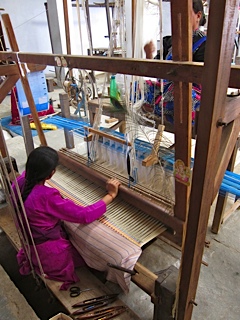
Les Soeurs are always interested to see what's going on locally on a textile level and during a recent trip to India we had the great good fortune to meet the remarkable and inspirational  octogenarian, Suraiya Hassan, who has given up her comfortable life in a wealthy Muslim family to live amongst, support and train the impoverished, unskilled widows of Hyderabad.


Suraiya Hassan


 By teaching them how to produce historical North Indian patterns on original-style looms - a skill generally lost or forgotten in the wake of modern technology - she has provided, over the last eight years, a much needed source of income for their families whilst re-introducing the traditional skills of spinning and weaving.  And, as if that wasn't enough she has also provided - and helps run - a small school for their children.  All this at an age when most people are enjoying the a well-earned rest.


The textiles are woven in both silk and cotton (or both) and a length of five meters can take two women, working together on a loom, anywhere upwards of three months to produce (only 3 inches a day).  Suraiya sources all the old patterns and motifs from original items of clothing that she collects and very often just small scraps, all that remains of a ceremonial jacket or sari.


This is not a charity (Suraiya is quiet adamant she will not take contributions) but if you would like to support this worthy venture and are interested in purchasing a length of these frankly gorgeous reproductions (a minimum length of 10m as it takes two days to set up the loom for each new colourway), Suraiya will take orders and can arrange to send you photographs and details via email from which to choose.


All I can add is that these fabrics are ridiculously well-priced considering the work that goes into them, though import tax would most probably bring the costs up to a more reasonable level.


suraiyas2009@gmail.com