| ||||||
|

Showing posts with label knitting. Show all posts
Showing posts with label knitting. Show all posts
Sunday, 31 July 2016
..... darn it......


Friday, 12 February 2016
... feeling like February......
February has arrived and for most of us it has brought with it wet weather, grey skies and a bracing wind after what had been a mild warm winter so far.
On the positive side, the time indoors will be spent productively dealing with those overdue sewing tasks, whilst making an early start on the spring cleaning chores before our workshop season arrives with Åsa Tricosa's Weekend Knitting Masterclass at the end of April. Something really exciting to look forward to (Åsa's workshop, not the chores, that is).....
On the positive side, the time indoors will be spent productively dealing with those overdue sewing tasks, whilst making an early start on the spring cleaning chores before our workshop season arrives with Åsa Tricosa's Weekend Knitting Masterclass at the end of April. Something really exciting to look forward to (Åsa's workshop, not the chores, that is).....

Asa Södeman is never one to sit back on her laurels; she's off to the Edinburgh Yarn Festival in March where you will find her hosting a couple of three-hour demonstrations: one on Collars and Cuffs, and the other on the Marlisle technique, a new system of creating decorative texture and colour shifts in handknitted fabric with a particular focus on seamless knitting in the round. Her workshop here will concentrate on tailoring beautifully crafted, top-down garments, with special attention to all those details that make for an expertly finished, knitted garment. As a moderately competent knitter myself, I'm looking forward to learning those professional touches Åsa is celebrated for, as well as assimilating some of her wonderful Scandinavian colour sense.
Edinburgh seems to be the place to be at the moment for anyone into textiles, yarns, and all things in-between. Fiona Rutherford, who will be leading her first workshop, Tapestry Weaving, with us in September this year, is starting her year with an exhibition of new tapestries at CONVERGE 2016 Visual Arts Scotland, 29th January - 20th February, "I'm delighted that my triptych, "Familiar Rhythms", has been selected for this exciting mix of fine and applied art and design showing at the RSA galleries". She'll also be showing a selection of her tapestries under the theme "Fragments" at the Knitting & Stitching Show, Royal Highland Centre, Edinburgh, from 28th April to 1st May, when she herself will be available to talk to. Well worth a visit!

During Fiona's workshop here, participants will be using lightwieght wood frame looms and a vibrant range of her personal Swedish cotton and linen yarns to weave colour and shape. Whether you are new to tapestry weaving or you want to take time to expand your ideas and weaving technique further in a creative environment, Fiona will guide you through the steps of how to create a small tapestry mounted and ready for you to take home.
If, however, your neck of the woods happens to be Stateside, and Vermont at that, you might like to take the opportunity to view the work of innovative and talented "stitch artist", Emily Barletta whose work will be on view at the exhibition, Intimacy and Materiality,at the Helen Day Arts Centre in Stowe.

We still have a few places remaining on Julie Arkell's Workshop here: Birds on a Table at the beginning of June. Julie's events here are always a joy, and participants this year will be encouraged to bring nature books they love, a favourite shell, dried flowers or any other nature find, all of which will be used to populate their unique nature table. As usual, our regular workshop leader and firm favourite,Julie, will be sharing some her celebrated paper maché, knitting, stitching and collating techniques.

We know that Julie would just love the fabrics of Kekfesto Cotton, a small UK importing company run by the aficionado, Gilly Thomson, which sells dozens of Hungarian, indigo printed, patterned fabrics. Reminiscent of Dutch Delft, but also remarkably similar to traditional hand-printed textiles of Japan, these textiles originally came from India, delivered as presents to the French court in the C17th and immediately became fashionable among ladies and nobles . By the turn of the C18th more than a hundred workshops were operating in Hungary with printing technology and patterns that were top secret within each particular guild. Today only eight workshops remain, and whilst still producing the traditional patterns they also experiment with modern ones. Luckily for us, Gilly stocks most of them.


Enjoy a fabric-full February!
Katie
Tuesday, 5 February 2013
.... knitting our socks off.......
Makes a nice change to have some quiet time down here in South West France. I recently finished knitting a wrap in cashmere and am now busily completing another one using up some old cotton tweed I had. With the end in sight, I have suddenly been inspired to knit socks and/or slippers with other remnant yarns. I taught myself to knit simple socks a few years ago and feel it's time to try something a little more complicated as they don't take very long to make and are incredibly satisfying. Here are five patterns that you might find inspiring - some more difficult than others and most free to download (though you may need to register on-site).
We still have a couple of places left on both Patricia Roberts knitting workshop in May, and Marion Foale's in October if you'd like to learn a few techniques and design tricks by the experts.


We still have a couple of places left on both Patricia Roberts knitting workshop in May, and Marion Foale's in October if you'd like to learn a few techniques and design tricks by the experts.


cocoknits

And on a different subject you might be interested in something a tad more upmarket, but you never know, coming up in April :
LONDON ANTIQUES FAIR
SPRING: 23 - 28 April 2013
Wednesday, 28 March 2012
a conversation with Patricia Roberts.........
I first met Patricia Roberts in person a couple of years ago, when I approached her about the possibility of her leading a knitting workshop for Les Soeurs Anglaises, but I have been visiting her wonderful shop in Kinnerton Street, London for many years and known her by reputation for far, far longer. In fact, I can honestly say that Patricia and her designs were responsible for my taking up needles to attempt something a little more serious and fashionable than the ubiquitous stripy scarves I had been making for long-suffering relatives for years. Complicated some of of her designs may be, but worth the effort, always.
So I thought it about time to find out a little more about her personal stitching history, and I'm sure you will find it as intriguing as I did.


So I thought it about time to find out a little more about her personal stitching history, and I'm sure you will find it as intriguing as I did.
What is your first memory
of knitting? Do you remember the first
item you knitted and do you still have it?
My very first memory of knitting was
from when I was about 5 years old and my mother knitted me a red scarf to prove
to my father that she could knit. I had to wear it to school and I was so
embarrassed, because of all the dropped stitches.

My mother disliked anything
homemade, because as a girl she had
always had home made clothes and longed for shop bought ones. I don’t think my
mother ever knitted again after the red scarf, and my father’s teasing. So it was my grandmother, who was a good
craftswoman, who taught me to knit, when I was six. Most of my friends had
small rosebud dolls, which their mothers had knitted clothes for from “Women’s
Weekly” patterns. My mother bought me the doll, but as I didn’t have the
patterns, I made up my own, the first item being a fully fashioned (I was
obsessed with increasing and decreasing) little dress in fine yellow wool with
blue spots on it. I don’t know what happened to it, but I was very proud of it
at the time. I have continued to be obsessed with shape in conjunction with stitch craft.
From where do you get your inspiration?
Inspiration can come from anywhere
and anything and often an amalgam of different inspirations uniting to become
something, which has very little relationship with the original. For instance
one of my designs was an amalgam of
Fuzzypeg’s coat from the “Little
Grey Rabbit” books combined with a quilted cup and saucer.


Fuzzypeg's coat A Patricia Roberts' pullover
How long is the process from first idea to finished item?
The length of time depends on how complicated the design is. For
instance if a design has a particularly large complicated chart, the chart alone
will take ages to complete and developing the stitches can be a slow process.
How do you arrive at the final design of an item?
The designs evolve as I work on them, particularly the
stitches. I do a sketch of the shape of the garment and a rough idea of the
stitches, then work on a stitch block, working the stitches out on graph paper
and at the same time knitting, unraveling and reknitting until it is correct.
The shape of the garment is particularly important and I work out the best use
of the stitches within its dimensions.

Patricia Roberts' designs
Which fashion designers were you
most influenced by when you first started?
A french
designer called Lil, whose designs “Lil pour l’Autre” machine knits were so cleverly shaped. In the late 60’s and early 70’s they also had
their own brand of luxury hand knitting yarns.


Lil pour l'Autre designs circa 1970
At what stage did you consider yourself a
“professional
knitwear designer”?
When I first saw one of my designs in a
magazine. It was a yellow cabled sweater in “Honey” magazine.

Which
current designer’s work are you most excited by?
I have the greatest regard for John
Galliano’s work. It is often so cleverly executed. It is such a pity about his
drunken comments.
John Galliano for Vogue
In which direction do you see hand-knitting going?
Currently the style is leaning towards
the retro, always good for hand knits.


Original 1950 and 1960 knitting patterns
What one
item/piece of equipment/skill (other than needles and yarn) do you think is essential for the successful
knitter?

A tape measure.
What is it you enjoy about teaching knitting?
Last year
we had such an enthusiastic group of participants. Each had brought along a
garment that they had knitted previously, which made a good talking point.
Everyone was set the same brief and it was interesting to see how they all came
up with something different.

Patricia's Knitting Workshop, Les Soeurs Anglaises, 2011
What are
you looking forward to during your visit to Les Soeurs Anglaises?
Beautiful
surroundings, the food, the visit to the secret brocante, the musical evening;
it was all such fun.

A bowl of pasta on the last evening
Thank you Patricia and we look forward to seeing you at the end of May.
Friday, 2 April 2010
Creative Workshop Stimuli
One of the really great things about running creative workshops at our house here in France is that you get to meet incredibly creative people! And I'm not just talking about the workshop leaders, although that goes without saying. Some participants arrive already creatively charged, ready to take on a new challenge or improve an existing one, like Rebecka Ryberg Skott, whose extraordinary photographs never cease to amaze (and entertain) me;

and Jone Hallmark, whose creativity never ceases.

Others present themselves on arrival as inexperienced or dabblers in the arts and crafts, but quickly discover through the workshop leaders' encouragement and teaching, the artist within, and head home with unique and beautiful items that bring back to life their neglected or forgotten creative inner child.
This is also very much the case with the Argentine Tango workshop led by London's top teachers, Bianca and Sasha of Rojo y Negro.
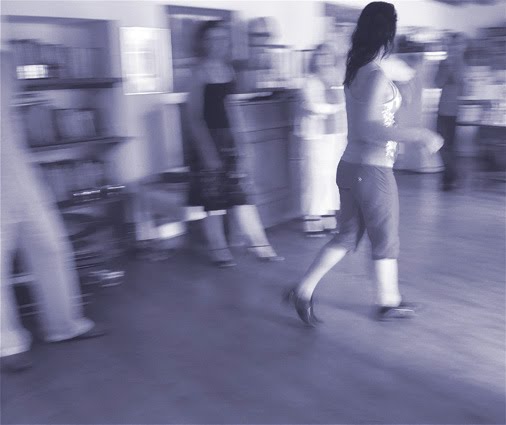

Cries of "Oh, I can't dance", or "I have two left feet" can be heard in the nervous mutterings of participants new to this amazing dance (mostly from the men it has to be said), but within a couple of hours, Bianca has demonstrated the basics and the fun of learning something completely new has become both stimulating, gratifying and totally rivetting. Of course, after only one workshop you can't expect to be able to dance the Argentine Tango as well as, say Geraldine Rojas, but does it really matter? The enjoyment you get from simply being able to hold your own on the dance floor, in time with the music, is pretty hard to beat. And learning the moves amongst an enthusiastic group of like minded people is the nearest you're going to get to the insouciant pleasure of our childhoods.
Returning to inspirational arts and crafts, take a look at Cathy Cullis' work. I recently discovered her beautiful and unusual stitch work and photographs and am now an avid follower of her inspirational blog. This one reminded me of Claire Montgomerie's colours whose workshop kicks off our 2010 season in May.

And if you're into second hand clothes take a gander at Prance and Swagger, where you can see, and buy online, some pretty fabulous fifties frocks (one or two perfect for the Argentine Tango) amongst lots of other vintage goodies - especially interesting for those of you living in the States as the postage charges will obviously be much lower.

Subscribe to:
Posts (Atom)