| ||||||
|

Showing posts with label textiles. Show all posts
Showing posts with label textiles. Show all posts
Sunday, 31 July 2016
..... darn it......


Friday, 12 February 2016
... feeling like February......
February has arrived and for most of us it has brought with it wet weather, grey skies and a bracing wind after what had been a mild warm winter so far.
On the positive side, the time indoors will be spent productively dealing with those overdue sewing tasks, whilst making an early start on the spring cleaning chores before our workshop season arrives with Åsa Tricosa's Weekend Knitting Masterclass at the end of April. Something really exciting to look forward to (Åsa's workshop, not the chores, that is).....
On the positive side, the time indoors will be spent productively dealing with those overdue sewing tasks, whilst making an early start on the spring cleaning chores before our workshop season arrives with Åsa Tricosa's Weekend Knitting Masterclass at the end of April. Something really exciting to look forward to (Åsa's workshop, not the chores, that is).....

Asa Södeman is never one to sit back on her laurels; she's off to the Edinburgh Yarn Festival in March where you will find her hosting a couple of three-hour demonstrations: one on Collars and Cuffs, and the other on the Marlisle technique, a new system of creating decorative texture and colour shifts in handknitted fabric with a particular focus on seamless knitting in the round. Her workshop here will concentrate on tailoring beautifully crafted, top-down garments, with special attention to all those details that make for an expertly finished, knitted garment. As a moderately competent knitter myself, I'm looking forward to learning those professional touches Åsa is celebrated for, as well as assimilating some of her wonderful Scandinavian colour sense.
Edinburgh seems to be the place to be at the moment for anyone into textiles, yarns, and all things in-between. Fiona Rutherford, who will be leading her first workshop, Tapestry Weaving, with us in September this year, is starting her year with an exhibition of new tapestries at CONVERGE 2016 Visual Arts Scotland, 29th January - 20th February, "I'm delighted that my triptych, "Familiar Rhythms", has been selected for this exciting mix of fine and applied art and design showing at the RSA galleries". She'll also be showing a selection of her tapestries under the theme "Fragments" at the Knitting & Stitching Show, Royal Highland Centre, Edinburgh, from 28th April to 1st May, when she herself will be available to talk to. Well worth a visit!

During Fiona's workshop here, participants will be using lightwieght wood frame looms and a vibrant range of her personal Swedish cotton and linen yarns to weave colour and shape. Whether you are new to tapestry weaving or you want to take time to expand your ideas and weaving technique further in a creative environment, Fiona will guide you through the steps of how to create a small tapestry mounted and ready for you to take home.
If, however, your neck of the woods happens to be Stateside, and Vermont at that, you might like to take the opportunity to view the work of innovative and talented "stitch artist", Emily Barletta whose work will be on view at the exhibition, Intimacy and Materiality,at the Helen Day Arts Centre in Stowe.

We still have a few places remaining on Julie Arkell's Workshop here: Birds on a Table at the beginning of June. Julie's events here are always a joy, and participants this year will be encouraged to bring nature books they love, a favourite shell, dried flowers or any other nature find, all of which will be used to populate their unique nature table. As usual, our regular workshop leader and firm favourite,Julie, will be sharing some her celebrated paper maché, knitting, stitching and collating techniques.

We know that Julie would just love the fabrics of Kekfesto Cotton, a small UK importing company run by the aficionado, Gilly Thomson, which sells dozens of Hungarian, indigo printed, patterned fabrics. Reminiscent of Dutch Delft, but also remarkably similar to traditional hand-printed textiles of Japan, these textiles originally came from India, delivered as presents to the French court in the C17th and immediately became fashionable among ladies and nobles . By the turn of the C18th more than a hundred workshops were operating in Hungary with printing technology and patterns that were top secret within each particular guild. Today only eight workshops remain, and whilst still producing the traditional patterns they also experiment with modern ones. Luckily for us, Gilly stocks most of them.


Enjoy a fabric-full February!
Katie
Saturday, 7 November 2015
..... with winter on our heels.....
|
|


|
Thursday, 6 September 2012
... autumn nearly upon us...
Whilst the mornings and evenings definitely have a touch of coolness about them, by midday we are out and about in sleeveless t-shirts, and a dip in the pool is on the agenda. Last weekend saw the regular village brocante, which seems to be getting bigger and better every month - which is great news for our textile workshop participants. Here are a few of my finds....!

a set of pure linen tea towels with "CM' hand embroidered on each

a divine 1920's doll's dress

with matching slip, both embroidered with the initial "J"

an original nurse's apron from the 1930's

some unfinished smocking

red and white buttons on hand embroidery

a piece of perfect stitching on the edge of a pink linen sheet

and finally a pair of stitched leather gloves for someone I know can make a donkey's ear out of a silk purse.

Homeward bound with my purchases, on a perfect French September afternoon, I came across of flock of geese in the middle of the road, on their way.... who knows where. I tried to herd them away from the possibility of on-coming traffic and they finally flew off.... yes, further down the road! I watched as they finally made their way to the side and safety.


When life is good here, it is paradise enow.....
Sunday, 29 January 2012
If you're ever in Hyderabad....
There's nothing like travel to broaden your mind and make you realize what difficult lives most people in the world have just trying to keep body and soul together.
Les Soeurs are always interested to see what's going on locally on a textile level and during a recent trip to India we had the great good fortune to meet the remarkable and inspirational octogenarian, Suraiya Hassan, who has given up her comfortable life in a wealthy Muslim family to live amongst, support and train the impoverished, unskilled widows of Hyderabad.

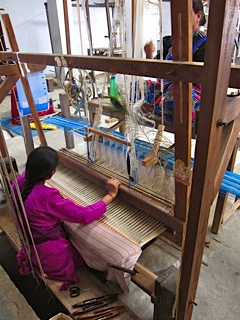
By teaching them how to produce historical North Indian patterns on original-style looms - a skill generally lost or forgotten in the wake of modern technology - she has provided, over the last eight years, a much needed source of income for their families whilst re-introducing the traditional skills of spinning and weaving. And, as if that wasn't enough she has also provided - and helps run - a small school for their children. All this at an age when most people are enjoying the a well-earned rest.




All I can add is that these fabrics are ridiculously well-priced considering the work that goes into them, though import tax would most probably bring the costs up to a more reasonable level.
suraiyas2009@gmail.com
Les Soeurs are always interested to see what's going on locally on a textile level and during a recent trip to India we had the great good fortune to meet the remarkable and inspirational octogenarian, Suraiya Hassan, who has given up her comfortable life in a wealthy Muslim family to live amongst, support and train the impoverished, unskilled widows of Hyderabad.

Suraiya Hassan
By teaching them how to produce historical North Indian patterns on original-style looms - a skill generally lost or forgotten in the wake of modern technology - she has provided, over the last eight years, a much needed source of income for their families whilst re-introducing the traditional skills of spinning and weaving. And, as if that wasn't enough she has also provided - and helps run - a small school for their children. All this at an age when most people are enjoying the a well-earned rest.


The textiles are woven in both silk and cotton (or both) and a length of five meters can take two women, working together on a loom, anywhere upwards of three months to produce (only 3 inches a day). Suraiya sources all the old patterns and motifs from original items of clothing that she collects and very often just small scraps, all that remains of a ceremonial jacket or sari.

This is not a charity (Suraiya is quiet adamant she will not take contributions) but if you would like to support this worthy venture and are interested in purchasing a length of these frankly gorgeous reproductions (a minimum length of 10m as it takes two days to set up the loom for each new colourway), Suraiya will take orders and can arrange to send you photographs and details via email from which to choose.

All I can add is that these fabrics are ridiculously well-priced considering the work that goes into them, though import tax would most probably bring the costs up to a more reasonable level.
suraiyas2009@gmail.com
Subscribe to:
Posts (Atom)